38 health claims on food labels are standardized and regulated
Code of Federal Regulations Title 21 - Food and Drug Administration (1) Nutrients shall be added to the food to restore nutrient levels so that the product is not nutritionally inferior, as defined in § 101.3 (e) (4) of this chapter, to the standardized food as... Label Claims for Food & Dietary Supplements | FDA Among the claims that can be used on food and dietary supplement labels are three categories of claims that are defined by statute and/or FDA regulations: health claims, nutrient content claims,...
How Dietary Supplements (Foods) Became Regulated Conventional Foods and Dietary Supplement Labels Become Standardized There was no uniform standard of labeling for conventional foods and dietary supplements up until 1990, so the Nutrition Labeling and Education Act (NLEA) was passed by Congress that year to require most packaged foods to bear nutrition labeling.

Health claims on food labels are standardized and regulated
Food Labelling - Canada.ca Labelling on food helps Canadians make healthy and informed choices about the foods they buy and eat. Helping you make healthy choices Through the Food and Drugs Act, Health Canada regulates the labelling of food products in Canada. Regulations published on January 1, 2003: Make nutrition labelling mandatory on most food labels. Nutrient Content Claims | FDA See Claims That Can Be Made for Conventional Foods and Dietary Supplements for definitions of claims. Final Rule: Food Labeling: Nutrient Content Claims; Alpha-Linolenic Acid, Eicosapentaenoic ... Factual Food Labels: A History of Food Labels A few decades later in 1990, the FDA, through the Nutrition Labeling and Education Act, mandated that all food companies were required to make consistent claims and include a detailed, standardized nutrition facts panel on all products intended to be sold.
Health claims on food labels are standardized and regulated. Understanding Food Labels and Health Claims - Maricopa Health Claims & Foods To keep companies from making false claims, the FDA provides food manufacturers' regulations in putting labels on packages that promote health. There are three levels of health claims: A health claim is supported by scientific evidence. An example is "reduces heart disease." Labelling requirements for infant foods, infant formula and human milk Voluntary claims and statements for infant foods There are specific requirements applicable to foods intended solely for children under two years of age. Refer to Nutrient Content Claims on Foods Intended Solely for Children Under Two Years of Age and Health Claims for Children Under Two Years of Age for more information. Age Claims on Infant Foods eCFR :: 21 CFR Part 101 -- Food Labeling § 101.1 Principal display panel of package form food. The term principal display panel as it applies to food in package form and as used in this part, means the part of a label that is most likely to be displayed, presented, shown, or examined under customary conditions of display for retail sale. The principal display panel shall be large enough to accommodate all the mandatory label ... Ministry of Health, Labour and Welfare: Food with Health Claims, Food ... FOSHU is intended to be consumed for the maintenance / promotion of health or special health uses by people who wish to control health conditions, including blood pressure or blood cholesterol. In order to sell a food as FOSHU, the assessment for the safety of the food and effectiveness of the functions for health is required, and the claim ...
Labelling requirements for fats and oils - Canadian Food Inspection Agency The claim must appropriately state the oil used and should read, in this instance, "popped in hydrogenated 100% corn oil" or "popped in fully hydrogenated 100% corn oil". Health claims Heart symbols. Heart symbols are often found on the labels of fat and oil products. Refer to Heart symbols and heart health claims for more information. Nutrition chap 12 quiz Flashcards | Quizlet A. A nutrient claim is. A. a declaration on food packages to indicate a possibly beneficial nutrient. B. not federally regulated. C. more specific information about what the food product contains. D. a statement on the label about how that nutrient may affect the human body's structure. E. All of the above. Label Claims for Conventional Foods and Dietary Supplements The Nutrition Labeling and Education Act of 1990 (NLEA) permits the use of label claims that characterize the level of a nutrient in a food (i.e., nutrient content claims) if they have been ... CH 2 - NUTRITION Flashcards - Quizlet Structure/function claims on dietary supplement labels are not regulated as rigorously as health claims. TRUE. Serving sizes are standardized on food labels to allow consumers to compare products. ... Nutrient content and health claims are approved by the: FDA. A _____ claim refers to a relationship between a nutrient, food, or dietary ...
Health claims on functional foods: the Japanese regulations and an ... Health claims on functional foods: the Japanese regulations and an international comparison The Japanese scientific academic community defined 'functional food' early in the 1980s. That is, functional foods are those that have three functions. The primary function is nutrition. The secondary function is a sensory function or sensory satisfaction. Are Food Labels Effective as a Means of Health Prevention? Besides, we should consider that nutrition/health claims, regulated by Reg. CE 1924/2006, and sometimes front-of-pack labels (also known as extrinsic cues) might discourage the proper use of the label in selecting a product, since they usually are well visible on the front side of the package and they take a shortest time to be read. 25,26 Even ... Newly established regulation in Japan: foods with health claims The Japanese government enacted a new regulatory system called 'Foods with health claims' in April 2001, which consists of 'Foods for Specified Health Use' (FOSHU) and 'Foods with Nutrient Function Claims' (FNFC). The FOSHU was set up by the Ministry of Health and Welfare in 1991 to approve descript … Labelling requirements for meat and poultry products - Food labels ... The Food and Drug Regulations (FDR) and the Safe Food for Canadians Regulations (SFCR) require the labels of prepackaged meat products (definition) to carry the name and principal place of business of the responsible party [218(1)(b), SFCR; B.01.007(1.1)(a), FDR]. Non-prepackaged meat products interprovincially traded, imported or exported must ...
What Do Those 'Healthy' Food Labels Really Mean? - Eater In addition to structure-function claims, companies use information about ingredients ("made with real fruit"), FDA regulated terms like "good source of," and third-party labels like the American...

chapter 2 true and false Flashcards - Quizlet food companies are prohibited from using nutrient or health claims in food labels that are not approved by the FDA false Yogurt parfaits offered at some fast food restaurants are a more healthful choice than fruit true the number of servings of each food group recommended in the USDA food patterns is based on age, gender, and activity level false
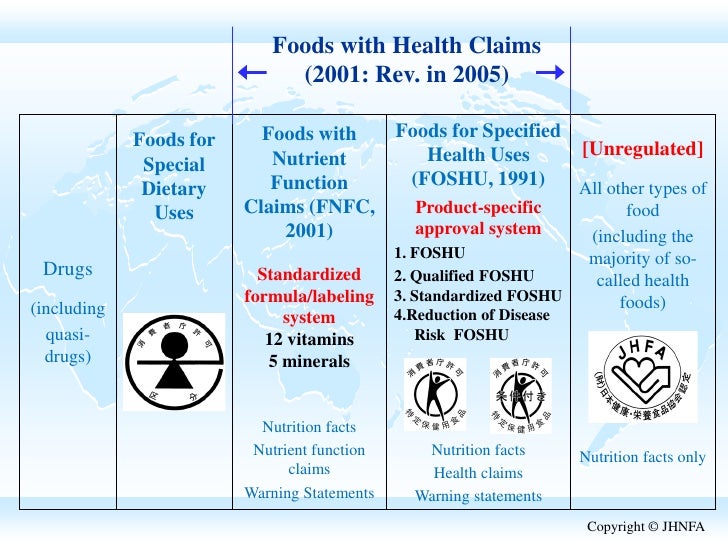
Japan Regulations & Guidelines for Functional Foods
Nutrient Claims on Food Labels | Home & Garden Information Center Lean Claims. Lean. Contains less than 10 grams total fat, 4.5 grams or less saturated fat, and less than 95 milligrams cholesterol. Extra lean. Contains less than 5 grams total fat, less than 2 grams saturated fat, and less than 95 milligrams cholesterol. *compared to the reference, or regular, food this would replace.
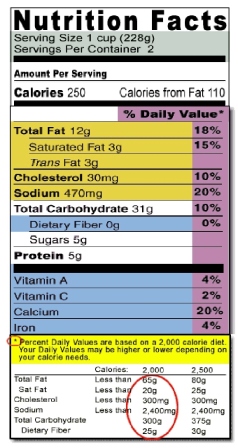
How to Understand and Use the Nutrition Facts Label
Questions and Answers on Health Claims in Food Labeling | FDA 4. Has the FDA ever revoked an authorized health claim? The FDA has authorized 12 health claims since 1990. On October 31, 2017, the agency issued a proposed rule to revoke the regulation that ...
Post a Comment for "38 health claims on food labels are standardized and regulated"